Stay updated with expert perspectives, custom lithium battery technology guides, downhole power innovations, and regulatory updates from our engineering team.
Choosing Small EV Battery Packs takes more than comparing price tags or advertised range. A compact battery may suit a light electric vehicle, but only when its voltage, capacity, dimensions, and connector match the vehicle’s requirements. Check the manufacturer’s specifications before buying. A pack that looks right online may not fit the battery compartment or work with the existing controller. Small details matter.
Battery chemistry, battery management system, charging limits, and expected cycle life also deserve attention. Ask for a clear datasheet and confirm whether the stated capacity is nominal or usable. Numbers can be confusing. A higher capacity figure does not automatically mean better performance if the pack is too heavy, charges slowly, or lacks suitable protection. And real-world range varies with speed, temperature, terrain, load, and driving habits.
This guide introduces seven practical tips for assessing compatibility, quality, safety features, warranty terms, and total ownership cost. It also explains what to ask a seller and which claims need verification. Look for traceable product information, clear support channels, and specifications that agree across the listing and documentation. If details conflict, pause and seek clarification. That may feel overly cautious, but battery choices affect both vehicle performance and day-to-day reliability. No single pack is right for every EV. Compare the pack with your vehicle manual and intended use before deciding.
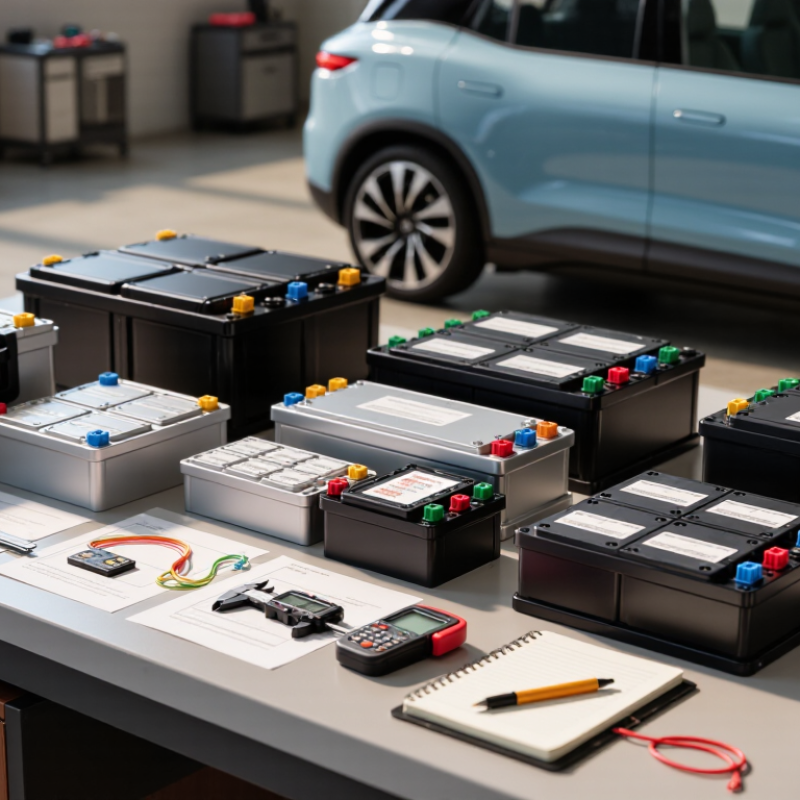
Before choosing a small EV battery pack, write down the device’s operating voltage, typical current, and peak current. Check the device label or manual, then verify the figures during real use if possible. A motor may draw much more current when starting than while cruising. Brief peaks matter; they can trigger protection or cause a voltage drop.
Estimate energy needs in watt-hours: voltage multiplied by amp-hours. For runtime, divide the pack’s usable watt-hours by the device’s average power draw in watts. If a device averages 40 watts and needs to run for three hours, plan for at least 120 watt-hours before allowing for losses. Keep a margin for cold conditions, aging, and conversion inefficiency. The full rated capacity may not be available in practice.
Measure a typical trip or work session, not just a quiet test on a bench. Record how long the motor runs, when accessories are active, and how often the device stops and starts. A simple power meter can reveal surprises. It is tempting to size the pack to the exact calculation. That often leaves little room for a longer route or a tired battery. This estimate is still only an estimate, so compare it with real operating data before settling on pack capacity.
A small EV battery pack must match the vehicle’s electrical system, not just its advertised range. Check the controller and motor specifications before choosing voltage. A pack marked 48 V may not operate at exactly 48 V throughout charging and use, so confirm the controller’s permitted voltage range. Capacity is measured in amp-hours, but watt-hours better show stored energy: multiply volts by amp-hours. For example, a 48 V, 20 Ah pack stores about 960 Wh. More capacity can mean more range, but it can also add weight and size.
Physical fit deserves equal attention. Measure the battery compartment, including its narrowest opening, then check the pack’s full length, width, and height. Leave room for cables, connectors, mounting hardware, and airflow; a case that barely slides in may still block the cable exit. Check terminal position and polarity, too. Small details matter. The International Energy Agency’s Global EV Outlook 2024 reports that EV battery demand reached about 750 GWh in 2023, illustrating the scale and variety of today’s battery market. That figure does not identify a suitable pack for a specific vehicle, so rely on the vehicle’s own specifications.
Before ordering, compare the battery’s continuous current rating with the controller’s demand, and confirm that the charger is designed for the pack’s chemistry and voltage. I still double-check dimensions against a simple cardboard template; online measurements can be easy to misread. One compromise remains: a larger pack may offer more energy, but can upset weight distribution or use valuable cargo space. Check the fit in the actual mounting position.
Energy is calculated as nominal voltage × capacity. These illustrative pack configurations show why both voltage and amp-hour capacity matter: a higher voltage or greater capacity can mean more stored energy. Before buying, also confirm that the pack’s voltage is compatible with your motor and controller, and check its dimensions, connector, and battery chemistry.
With a small EV pack, chemistry shapes more than range: it affects weight, cost, usable capacity, and charging behavior. Compare lithium iron phosphate (LFP) with nickel-rich chemistries, not just advertised kilowatt-hours. LFP often offers lower cost and longer cycle life; nickel-rich cells typically store more energy per kilogram. The trade-off is real. The International Energy Agency’s Global EV Outlook 2024 reports that LFP reached about 40% of EV battery demand in 2023, up from under 10% in 2020. That growth makes LFP worth considering, but it is not a universal winner.
Ask about cycle-life test conditions, the warranty’s capacity threshold, and usable—not gross—pack size. The U.S. Department of Energy’s Alternative Fuels Data Center notes that many EV battery warranties cover at least eight years or 100,000 miles. Read the fine print. Small details matter. For charging, match the charger’s output to the pack’s accepted rate; a small pack may not use a high-power plug at full capacity. A modest home charger can work well for short daily trips, but actual charging time depends on pack size and temperature. I would not overvalue a headline cycle count: laboratory conditions rarely resemble cold mornings or hurried top-ups.
| Tip | What to Compare | Typical Facts and Trade-Offs | What to Check Before Buying |
|---|---|---|---|
| 1 | Choose chemistry for your use | LFP: generally long-lived and thermally stable, with lower energy density than many nickel-based cells. NMC: typically offers higher energy density in a compact pack. Lead-acid: usually heavier and less tolerant of repeated deep discharge. LTO: can support very long cycle life and high charge rates, but often has lower energy density and higher cost. | Consider pack weight, available space, expected daily range, climate, and how often the vehicle will be used. Chemistry alone does not determine pack quality. |
| 2 | Compare cycle life realistically | Illustrative ranges to about 80% of initial capacity are roughly 2,000–4,000 cycles for LFP, 500–1,500 for NMC, 200–500 deep cycles for lead-acid, and 5,000 or more for some LTO cells. Results vary substantially with cell design, temperature, and usage. | Ask how the cycle-life figure was tested, what capacity-retention endpoint was used, and whether the figure applies to the complete pack or only the cells. |
| 3 | Match the charger to the chemistry | Common maximum charging voltages per cell are approximately 3.6–3.65 V for LFP, 4.2 V for many NMC cells, and 2.7–2.8 V for many LTO cells. Lead-acid charging voltage depends on battery type and charging stage. | Use only a charger whose output profile and pack voltage are approved for the exact battery pack. These figures are typical examples, not universal settings. |
| 4 | Check charging speed and routine | Charge rate is commonly expressed as a C-rate: 1C is a current equal to the battery’s rated capacity per hour. Faster charging can increase heat and, depending on the battery, accelerate wear. | Confirm the pack’s permitted charging current, the charger’s current rating, and the expected time to charge. Follow the pack maker’s guidance, especially in very cold or hot conditions. |
| 5 | Compare usable energy, not just capacity | Watt-hours (Wh) describe stored energy: voltage (V) × amp-hours (Ah) = Wh. The usable amount can be lower than the rated amount because of operating limits, reserve capacity, and battery-management settings. | Compare rated Wh, usable capacity if stated, and the vehicle’s real-world energy use. Do not assume two packs with the same Ah rating store the same energy if their voltages differ. |
| 6 | Review the battery-management system and temperature limits | A battery-management system (BMS) can monitor cell voltage and temperature and help protect against overcharge, excessive discharge, and overcurrent. Protection features and temperature limits differ by pack. | Check for documented protection functions, operating and charging temperature limits, and whether the pack is suitable for the vehicle’s environment. Never charge a pack outside its specified limits. |
| 7 | Verify fit, compatibility, and support | Pack voltage, connector polarity, physical dimensions, mounting, discharge-current rating, and communication requirements can all affect compatibility. A cell-level specification does not guarantee that a finished pack fits a particular vehicle. | Confirm the vehicle’s required voltage and peak current, measure the mounting space, verify connector and BMS compatibility, and review the written warranty and safe-handling documentation. |
A small EV battery pack can look simple, but its safety depends on more than its size. Check the certification documents for the exact pack model, not just a similar cell or product family. Confirm what the certification covers, who issued it, and whether the model number matches the label. A printed mark alone is not enough. Ask for a test report or traceable documentation if details are unclear.
Small details matter. Read the operating limits before buying. Compare the pack’s rated voltage and continuous discharge current with your vehicle’s requirements; peak current is not a safe substitute for continuous capacity. Check the stated charging and discharging temperature ranges, too. A pack used outdoors may face cold mornings, hot enclosures, and limited airflow. Confirm that its protection system addresses overcurrent, overvoltage, and overheating, and ask how the pack should be mounted and connected. Avoid units with missing labels or vague instructions. It is tempting to choose the smallest, lightest option, but I would pause when basic limits are hard to verify. A tidy specification sheet can still leave important questions unanswered.
Before comparing prices, confirm the pack matches the vehicle’s electrical requirements. Check nominal and maximum voltage, continuous current, connector type, polarity, and physical dimensions. A plug that fits is not proof of compatibility. The battery management system must also support the vehicle’s charging method and expected loads. Ask for a clear datasheet, not just a capacity figure. I used to give that number too much weight.
Warranty terms deserve the same close attention. Read what is covered, for how long, and what evidence is needed for a claim. Look for clear limits on cycle life, capacity loss, and operating conditions. Ask whether the warranty covers shipping and inspection costs. Get the answers in writing. Small details matter.
Supplier reliability is harder to measure, but practical checks help. Request batch or cell traceability, test records, and instructions for storage and charging. Notice how the supplier handles specific questions: vague replies about voltage or warranty are a warning sign. A sample can reveal fit and finish, though it cannot prove long-term performance. I would compare several suppliers, even when one quote looks unusually convenient. That extra check can prevent an expensive mismatch.
Check the controller and motor specifications, then confirm the pack’s full voltage range. A “48 V” label does not tell the whole story.
Multiply volts by amp-hours to estimate watt-hours. For example, a 48 V, 20 Ah pack stores about 960 Wh. More capacity may add weight.
Measure the compartment’s narrowest opening, then compare length, width, and height. Leave room for cables, connectors, mounting hardware, and airflow. Measure twice.
Compare the pack’s continuous current rating with the controller’s demand. Peak current is not a substitute for continuous capacity.
Confirm that the charger matches the pack’s chemistry and voltage. I would check this twice; labels can be easy to misread.
Check documents for the exact pack model. Confirm the model number, what the certification covers, and who issued it. A printed mark alone is not enough.
Review charging and discharging temperature ranges, voltage, and current limits. Outdoor use can mean cold mornings and hot enclosures.
Ask whether protection covers overcurrent, overvoltage, and overheating. Check mounting instructions and terminal polarity. A larger pack may also shift weight or take cargo space.
Choosing Small EV Battery Packs starts with understanding how much power your device needs and how long it should run between charges. Check that the battery’s voltage matches the system, then compare its capacity and physical dimensions with the available space and expected workload. A pack that fits physically but cannot deliver sufficient energy may limit performance, while one with unsuitable voltage may not work properly.
Also consider battery chemistry, expected lifespan, charging time, and the conditions in which the pack will operate. Review built-in safety protections, relevant certifications, and operating limits such as temperature range. Before purchasing, confirm compatibility with your device and charger, read the warranty terms, and assess whether the supplier provides clear product information and dependable support. These checks can help you select a practical battery pack for your needs.