
1. Executive Overview & E-E-A-T Technical Baseline for Downhole Energy
In modern directional drilling, Measurement-While-Drilling (MWD) and Logging-While-Drilling (LWD) Bottom Hole Assemblies (BHAs) operate under some of the most aggressive physical and chemical conditions on Earth. Sub-surface hydrocarbon exploration and deep geothermal drilling force electronic instruments into High-Temperature High-Pressure (HTHP) boreholes where ambient temperatures routinely exceed 150°C (302°F) and can reach extreme peaks of 200°C (392°F). Simultaneously, mud pulse telemetry units, gamma ray sensors, directional magnetometers, and acoustic logging tools are subjected to relentless axial vibration, lateral whiplash, and severe stick-slip torsional shock.
Powering these downhole instruments requires zero-failure energy storage. Standard commercial or industrial lithium-ion batteries cannot be used downhole due to catastrophic thermal instability, severe electrolyte boiling, and internal short-circuit risks above 85°C. Instead, the global energy sector relies on specialized primary (non-rechargeable) MWD Downhole Battery Packs engineered around Lithium Thionyl Chloride (Li-SOCl2) and Lithium Bromine Chloride in Thionyl Chloride (Li-BCX) electrochemistries.
 Engineering Insight: The Cost of Downhole Power Failure
In deepwater offshore or ultra-deep horizontal drilling operations, tripping out a drill string to replace a failed downhole battery pack incurs NPT (Non-Productive Time) costs ranging from $50,000 to over $250,000 per occurrence. OEM battery selection is not merely a procurement item; it is a critical risk mitigation decision governing rig uptime, data integrity, and borehole safety.
With over 40 years of precision battery design experience, Excell Battery Co. provides engineered downhole battery packs built explicitly to neutralize passivation delays, resist structural delamination under 30G RMS random vibration, and deliver flat voltage profiles over multi-hundred-hour drilling runs.
2. Featured MWD & LWD Downhole Battery Pack Series Recommendations
To meet global OEM tool configurations (such as standard drop-in replacements for Schlumberger, Halliburton, Baker Hughes, Weatherford, and independent telemetry tool housing dimensions), Excell Battery manufactures several specialized downhole battery pack series. Below are our core engineered product recommendations:
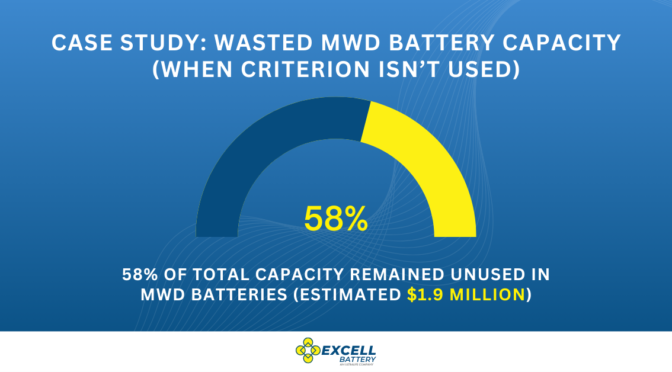
HTHP Ultra-Series (165°C - 200°C)
Designed for ultra-deep, high-pressure directional wells. Utilizes premium grade fused Li-SOCl2 cells with high-temperature glass-to-metal hermetic headers and high-density thermal shock damping sleeves.
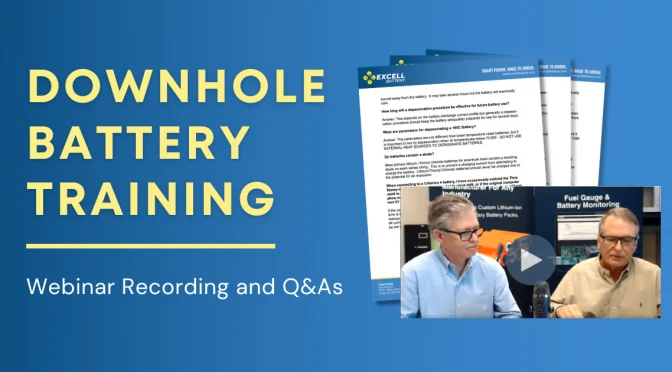
Pulse-Master Li-BCX Series (150°C)
Optimized for high-current pulse loads generated by electromagnetic (EM) telemetry systems and acoustic logging tools. Features reduced passivation resistance and rapid voltage response under load.
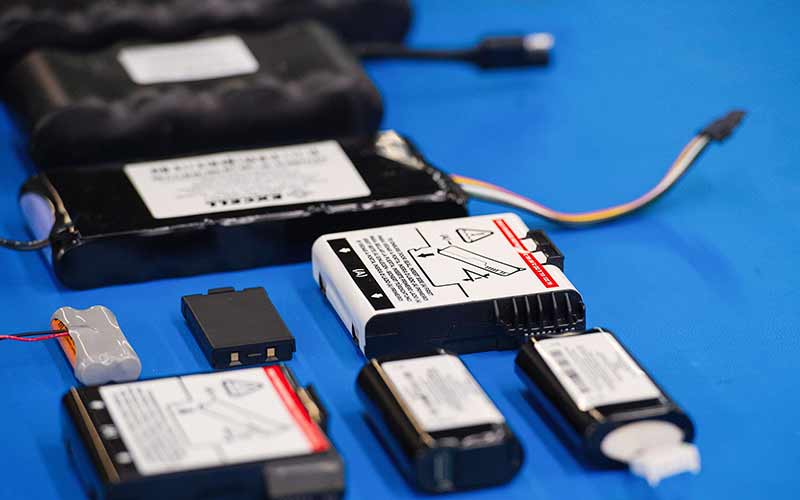
Ruggedized Directional Drilling Series
Specifically engineered for severe stick-slip and motor drilling environments. Integrated steel shock-housing with multi-stage potting compounds prevents cell tab fatigue and weld fracturing.
Comprehensive Engineering Specification Matrix
Selecting the correct MWD battery pack requires matching electrochemistry and physical construction to the expected borehole temperature profile and tool current draw. The table below outlines key technical parameters across our primary downhole offerings:
| Pack Configuration | Cell Chemistry | Max Temp (°C) | Nominal Voltage | Capacity (Ah) | Max Cont. Current | Primary Application Focus |
|---|---|---|---|---|---|---|
| MWD-150-5DD | Li-SOCl2 | 150°C | 18.0 V (5-cell) | 28.0 Ah | 1.5 A | Standard Mud-Pulse Telemetry & Gamma Tools |
| MWD-165-6DD-BCX | Li-BCX | 165°C | 21.6 V (6-cell) | 25.0 Ah | 4.0 A Pulse | High-Power EM Telemetry & Rotary Steerable |
| HTHP-180-10CC | Li-SOCl2 Premium | 180°C | 36.0 V (10-cell) | 5.2 Ah | 800 mA | Ultra-Deep HTHP Exploration Wells |
| HTHP-200-EXCELL | Modified Li-SOCl2 | 200°C | 14.4 V - 28.8 V | Custom Stack | 500 mA | Extreme Geothermal & Deep Sub-salt Wells |
| LWD-150-DUAL-PULSE | Li-BCX Hybrid | 150°C | 28.8 V (8-cell) | 56.0 Ah (Dual) | 5.0 A Peak | Logging-While-Drilling High Current Sonics |
3. Technical Information Gain: Passivation Science, Derating & Structural Engineering
To provide actionable technical value for downhole engineers, we must address the underlying electrochemical challenges that cause unpredicted battery failure during drilling operations.
A. Passivation Layer Mechanics & Field Mitigation Protocols
Lithium Thionyl Chloride cells inherently form a microscopic Lithium Chloride (LiCl) passivating layer over the metallic lithium anode during storage. While this passivating film is beneficial because it limits self-discharge to less than 1% to 2% per year at room temperature, it acts as an electrical insulator upon initial tool deployment downhole.
 Passivation Physics Formula & Voltage Delay
When a tool requests sudden high current from a passivated pack downhole, the voltage can temporarily drop below the tool's Low-Voltage Cut-Off (LVCO) threshold, causing tool reset or loss of survey data:
Vinstant = Vocp - Iload × (Relectrolyte + Rpassivation(t))
As continuous current flows, the LiCl film is mechanically disrupted and chemically dissolved, restoring full working voltage. To prevent downhole brownouts, Excell Battery incorporates pre-deployment load depassivation routines and offers optional automatic electronic depassivation circuits (AEDC) within the battery pack.
B. Thermal Derating & Capacity Retention at Elevated Temperatures
High borehole temperatures accelerate chemical self-discharge inside the cell. While a Li-SOCl2 cell exhibits negligible capacity loss at 25°C, operating continuously at 150°C increases the self-discharge rate up to 5%–8% per month. Furthermore, at temperatures approaching 180°C–200°C, internal chemical kinetics alter the open-circuit voltage profile.
- Self-Discharge Derating: Engineers must calculate total downhole operating life using thermal derating curves rather than nominal room-temperature ratings.
- Melting Point Safety Threshold: Pure metallic lithium has a melting point of approximately 180.5°C (356.9°F). For downhole applications operating above 165°C, specialized lithium alloy anodes (such as Lithium-Aluminium or Lithium-Magnesium alloys) are mandatory to elevate the anode melting point above 220°C, completely eliminating the risk of liquid lithium phase transformation and internal thermal runaway.
C. Mechanical Stabilization against 30G RMS Shock & Vibration
Vibration in the drill string consists of high-frequency axial impact and severe lateral harmonics. Unreinforced spot welds or standard wire leads will fracture within hours of drilling in hard rock formations.
Excell Battery mitigates structural failure through a multi-layered mechanical containment system:
- Nickel-Braze Heavy Duty Interconnects: Replacing thin nickel tabs with custom-formed, heavy-gauge multi-point spot-welded or laser-welded copper/nickel bridges.
- High-Temperature Silicone Potting: Encapsulating the entire cell stack in proprietary dual-component silicone compounds rated to 220°C, providing uniform shock absorption and preventing cell-to-cell thermal bridging.
- Precision Glass-Reinforced Fiberglass Outer Sleeves: Heavy-wall fiberglass tubes engineered to fit tightly inside standard 1.75-inch and 1.5-inch downhole pressure barrels.
- Integrated Diode Protection & Fusing: Every series string is fitted with high-temperature Schottky blocking diodes and chemical fuses to prevent back-charging or short-circuit propagation.
4. Future Global Procurement Trends for MWD & LWD Downhole Batteries
As global energy demand drives operators toward deeper offshore reservoirs, complex horizontal shale laterals (exceeding 15,000 feet lateral length), and high-enthalpy geothermal energy projects, downhole power procurement strategies are evolving rapidly. Supply chain and procurement leaders must align with five critical industry trends:
Trend 1: Demand for AI-Driven Telemetry Power Management
Modern smart BHAs optimize mud-pulse telemetry bandwidth dynamically using machine learning algorithms downhole. Consequently, power draw profiles are shifting from static continuous loads to complex variable pulse regimes. Procurement managers are increasingly seeking battery packs equipped with digital fuel-gauging and pulse-smoothing capacitor hybrids to extend operational hours by 20% to 30%.
Trend 2: Expansion of Ultra-Deep HPHT Geothermal Exploration
Geothermal energy wells routinely exceed 200°C ambient temperatures. Traditional oilfield downhole batteries fail rapidly under these conditions. The industry is standardizing on next-generation modified Lithium-Thionyl Chloride chemistries with ceramic separators and alloy anodes designed specifically for geothermal directional drilling.
Trend 3: Supply Chain Resilience & Nearshore Manufacturing
Geopolitical disruptions and long-distance shipping delays have highlighted the vulnerability of overseas lithium battery supply chains. Global drilling service companies are actively shifting procurement to North American manufacturers like Excell Battery (with manufacturing hubs in Canada and Houston, Texas) to guarantee short lead times, immediate engineering support, and reliable UN 38.3 shipping compliance.
Trend 4: Modular & Multi-Brand Tool Drop-In Standardization
Directional drilling service contractors are moving away from proprietary single-vendor battery formats. Future procurement favors modular downhole battery architectures that can be quickly reconfigured with interchangeable connectors (such as 4-pin Kintec, 7-pin shroud, or custom high-temp probe connections) to fit diverse telemetry tool fleets.
Trend 5: Extended Shelf Life & Storage Passivation Guarantees
Operators maintaining regional inventory hubs in Houston, Dubai, Aberdeen, and Singapore require battery packs that can sit in inventory for 12 to 24 months without catastrophic passivation or capacity degradation. Advanced cell electrolyte formulations with controlled passivation chemistry are becoming a mandatory RFP specification.
5. Industry & Product Development Trends: The Next Horizon
The downhole battery engineering landscape is advancing across three primary technical fronts:
Solid-State & Hybrid Primary Cells
R&D is focused on incorporating solid-state ceramic electrolytes into primary lithium cells to eliminate liquid electrolyte vaporization at temperatures exceeding 210°C, enabling safer geothermal drilling.
Real-Time Health Diagnostic Chips
Embedding micro-logging chips inside the battery potting that record maximum temperature exposure, cumulative vibration hours, and total consumed amp-hours for post-run forensic analysis.
Eco-Friendly Recycling Protocols
Establishing closed-loop recycling pathways for hazardous primary lithium and thionyl chloride waste, allowing extraction and re-refining of high-purity lithium salts for sustainable energy cycles.
Need Custom Engineered MWD Downhole Battery Packs?
Our downhole power engineers are ready to evaluate your tool power profile, shock/vibration parameters, and operating temperature constraints to build a reliable solution.
Send an Inquiry6. Product Procurement FAQ: Answering Essential Buyer & Engineering Queries
Below are technical answers to the most common questions asked by oilfield procurement specialists, drilling engineers, and tool design teams:
When stored at controlled temperatures below 20°C (68°F), primary Lithium Thionyl Chloride battery packs exhibit an exceptionally low self-discharge rate of under 1% per year, giving them an effective shelf life of up to 3 to 5 years. However, elevated storage temperatures accelerate both self-discharge and passivation film growth. We recommend storing downhole packs in climate-controlled facilities and conducting a field depassivation check if the pack has been stored for more than 12 months.
Field depassivation involves applying a controlled dummy load (typically sized to draw 20% to 50% of the cell’s maximum rated pulse current) across the battery terminals for 3 to 10 minutes while monitoring terminal voltage with a digital multimeter. Once the working voltage stabilizes above the nominal threshold (e.g., > 3.0V per cell under load), the passivation layer is successfully removed, and the pack is safe to load into the tool string.
Primary lithium downhole batteries are classified as Dangerous Goods (Class 9 Miscellaneous Dangerous Goods, UN 3090). To be legally transported by air (IATA), road (ADR/DOT), or sea (IMDG), every battery pack design must pass rigorous UN 38.3 transport safety testing, which includes altitude simulation, thermal testing, vibration, shock, external short circuit, impact/crush, overcharge, and forced discharge tests. Excell Battery provides certified UN 38.3 test documentation for all our downhole pack assemblies.
Standard lithium batteries utilize organic liquid electrolytes that vaporize and build extreme internal pressure at temperatures above 85°C, resulting in seal rupture or explosion. Furthermore, standard separator materials melt, causing internal short circuits. Downhole MWD cells feature liquid Thionyl Chloride inorganic electrolyte, high-temperature glass-to-metal hermetic seals, and specialized separator membranes engineered to remain chemically inert up to 200°C.
Excell incorporates multi-tier safety systems into every downhole assembly. First, cells are strictly capacity-matched and voltage-sorted during assembly to prevent cell reversal during deep discharge. Second, high-temperature ceramic blocking diodes prevent reverse current flow between parallel cell strings. Third, thermal fuses rated below the hazardous threshold isolate electrical faults before runaway temperatures can build. Finally, outer fiberglass sleeves contain potential mechanical failure.
Yes. We regularly engineer custom drop-in downhole battery packs tailored to proprietary tool housing diameters (including slim-hole 1.25-inch tools up to 3.0-inch heavy duty barrels), custom wiring harnesses, high-temperature PEEK connectors, and specialized anti-vibration end-caps.
7. Why Leading Global Energy Operators Partner with Excell Battery Co.
Choosing a downhole battery manufacturer requires absolute confidence in engineering capability, quality systems, and supply chain integrity. Excell Battery brings unmatched corporate strengths to global OEM partnerships:

North American Base. Global Oilfield Support.
As a subsidiary of Ultralife Corporation, Excell Battery combines specialized custom battery design agility with the financial strength, engineering depth, and global supply chain leverage of an international leader in mission-critical energy storage.

ISO 9001:2015 Certified Manufacturing
Rigorous quality management systems with full cell-lot traceability, 100% automated electrical testing, and complete X-ray inspection of internal weld points.

Direct Partnerships with World-Class Cell Manufacturers
We source top-tier, audited high-temperature cells directly from leading global manufacturers like Tadiran, Saft, Electrochem, Panasonic, and Murata.
Dedicated Downhole Battery Engineering Support
Our engineering teams in Houston, Calgary, and Vancouver assist clients through tool power modeling, prototype fabrication, UN 38.3 testing, and field failure root-cause analysis.
Internationally Recognized Accreditation & Quality Compliance
Excell Battery maintains strict compliance with international manufacturing and safety standards. Our facilities are audited regularly by independent accredited bodies:



8. Initiate Your Custom MWD Downhole Battery Design
Whether you require high-volume OEM supply of standard 150°C MWD battery packs or custom-engineered 200°C HTHP power modules for proprietary directional drilling tools, Excell Battery Co. has the technical expertise, manufacturing scale, and quality systems to deliver.
Click below to connect directly with our engineering team to request technical datasheets, request a custom pack quotation, or discuss your upcoming drilling project power requirements.
Accelerate Your Downhole Power Reliability Today
Consult with our Senior Downhole Battery Engineers. We provide full technical evaluations, custom engineering drawings, and rapid prototype turnarounds.
Send an Inquiry