In modern critical power applications—ranging from life-saving medical devices and explosive-atmosphere industrial instrumentation to severe downhole oil and gas exploration—a battery pack is only as reliable as its internal Smart Battery Management System (BMS). As energy densities in advanced Lithium-ion (Li-ion), Lithium Iron Phosphate (LiFePO4), and Lithium Primary (Li-SOCl2) chemistries escalate, the Smart BMS serves as the central brain responsible for real-time safety, cell balancing, state estimation, and host communication.
With over 40 years of specialized custom battery pack engineering, Excell Battery Co. (a subsidiary of Ultralife Corporation) has pioneered the development of high-reliability, intelligent battery monitoring hardware. Our North American engineering facilities in Surrey (British Columbia), Calgary (Alberta), and Houston (Texas) work directly with global Original Equipment Manufacturers (OEMs) to transition complex battery requirements into field-proven, certified energy solutions.
The Core Pillars of a Smart BMS
Unlike standard analog protection circuit boards (PCBs) that merely cut off power during hard over-voltage or short-circuit events, a true Smart Battery Management System incorporates microcontrollers (MCUs), precision analog front-ends (AFE), dynamic gas gauging fuel algorithms, and digital communication buses (SMBus, CANbus, Modbus, I2C). This enables bidirectionality, host machine handshaking, real-time telemetry, and field diagnostic capabilities.
Multi-Tiered Safety Protection
Hardware and software redline protections guarding against over-voltage, under-voltage, over-current, short circuits, thermal runaway, and sub-zero charge execution.
State of Charge (SoC) & Health (SoH)
Coulomb-counting paired with adaptive impedance tracking and machine learning models to deliver accurate battery state telemetry under dynamic operating conditions.
Active & Passive Cell Balancing
Cell-to-cell voltage equalization architectures that eliminate pack capacity degradation caused by cell imbalance, extending operational service life by up to 35%.
Standardized SMBus / CAN Communications
Seamless data interchange compliant with Smart Battery System (SBS) standards, broadcasting diagnostic logs, cycle counts, and real-time failure alerts to host systems.
2. Recommended Smart BMS Solutions for Key OEM Markets
Selecting the correct Smart BMS topology requires matching electrical limits, thermal tolerances, and regulatory standards to the specific application environment. Below are our five flagship Smart BMS and intelligent power architectures engineered for mission-critical industrial deployment.
Medical OEM
Medical-Grade SBS Compliant Smart BMS
Designed for surgical tools, portable ventilators, and hospital infusion pumps requiring strict adherence to IEC 62133-2 and ISO 13485 medical device standards. Features redundant secondary protection ICs, SMBus v1.1 data protocol, and zero-leakage sleep modes.
Built to withstand extreme shock, vibration, and operating temperatures up to +180°C (+356°F) in downhole oilfield environments. Utilizes ceramic substrates and wide-temp microcontrollers to monitor cell passivation and health in primary Lithium packs.
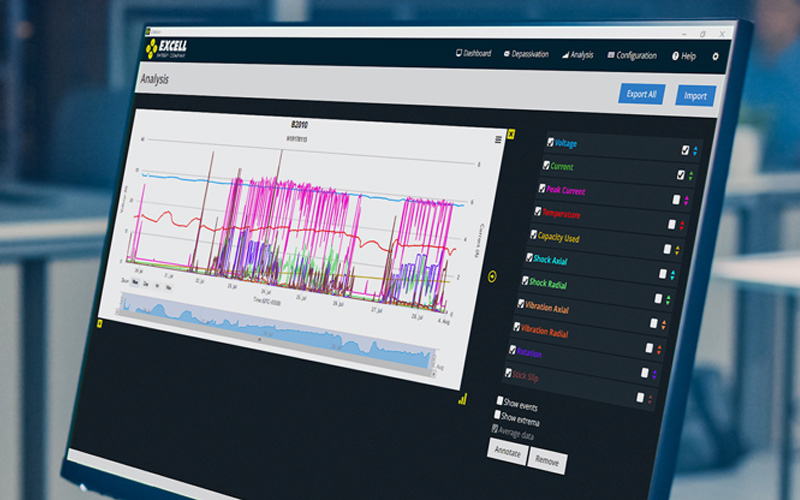
Excell’s proprietary smart telemetry interface designed for enterprise fleet operators. Communicates directly with rechargeable lithium-ion packs, outputting complete health history, temperature excursions, and remaining useful life (RUL) projections.
Engineered for hazardous industrial sites, chemical processing plants, and underground mining equipment. Encapsulated design featuring current-limiting resistors and redundant zener diodes to prevent thermal sparks in flammable vapor zones (Zone 0/1).
High-Power Active Balancing Smart BMS for AGV & Robotics
Built for high-discharge Autonomous Mobile Robots (AMR), industrial AGVs, and stationary energy storage. Features high-current solid-state MOSFET switches, active capacitive balancing, and dual temperature sensor channels per cell bank.
For specialized defense, aerospace, and remote telemetry OEMs requiring non-standard form factors, hybrid primary/secondary battery switching, and zero-standby parasitic power consumption (<1µA deep sleep mode).
3. Technical & Architectural Trends in Smart BMS Development
As global power demands shift towards higher energy densities and faster charging protocols, Smart Battery Management Systems are undergoing rapid architectural evolutionary shifts. OEM design engineers must understand these technology trends to future-proof their product roadmaps.
Edge AI & Neural Network State Estimation
Traditional Coulomb-counting and Open-Circuit Voltage (OCV) lookup tables struggle with non-linear voltage curves in LiFePO4 and advanced silicon-anode cells. Next-gen Smart BMS units integrate embedded neural network microcontrollers capable of real-time impedance spectroscopy (EIS), predicting internal micro-short circuits and battery degradation months before failure occurs.
Wireless BMS (wBMS) Topologies
Eliminating up to 90% of internal wiring harnesses and connector pins in multi-cell high-voltage packs, wireless BMS architectures utilize ultra-reliable 2.4GHz mesh networking protocols. This drastically reduces pack weight, eliminates failure points caused by physical vibration, and simplifies automated pack assembly.
Active Capacitive & Inductive Balancing
Traditional passive balancing dissipates excess energy from high-voltage cells as heat through resistors, reducing pack efficiency and generating thermal load. Smart BMS platforms are rapidly transitioning to active inductive balancing, transferring energy from high-state cells to weaker cells with over 90% transfer efficiency.
Wide Bandgap (GaN/SiC) Switching FETs
Replacing traditional silicon MOSFETs with Gallium Nitride (GaN) and Silicon Carbide (SiC) semiconductors lowers switching resistance and thermal generation by over 60%. This allows Smart BMS boards to handle continuous currents exceeding 200A in compact, passively cooled enclosures.
Encrypted Cyber-Physical Security
With smart batteries increasingly connected to cloud networks and IoT gateways, securing BMS firmware against unauthorized tampering, unauthorized cell cloning, and cyberattacks has become mandatory. Smart BMS boards now incorporate hardware security modules (HSM) featuring AES-256 encrypted authentication.
ISO 26262 & IEC 61508 Functional Safety
Critical industrial and medical equipment increasingly demand formal Functional Safety certification (SIL 2/3 and ASIL D). Modern Smart BMS electronics incorporate dual-core lockstep processors and hardware self-testing logic to guarantee safe state degradation in the event of a single component failure.
4. Global B2B Procurement Trends & Supply Chain Strategies
Procuring Smart Battery Management Systems in today’s volatile international landscape requires balancing technical specifications with geopolitical risk mitigation, regulatory compliance, and total cost of ownership (TCO). Supply chain executives and procurement directors are adapting to several macro procurement shifts:
Key Procurement Priorities for B2B Buyers
Nearshoring & Regional Manufacturing: Global OEMs are actively de-risking single-region supply chains by shifting custom BMS assembly and battery integration to audited North American facilities (such as Excell Battery’s ISO 9001 plants in Surrey, BC and Houston, TX).
Regulatory & EU Battery Passport Compliance: Modern smart BMS hardware must store complete cell origin data, carbon footprint tracking, and material composition to satisfy upcoming European Union Battery Regulations and US Inflation Reduction Act (IRA) sourcing mandates.
Cell Supplier Neutrality & Audited Tier-1 Sourcing: Top-tier custom pack assemblers must maintain direct relationships with globally validated cell manufacturers (including Tadiran, Saft, Panasonic, Samsung SDI, LG Energy Solution, and Molicel) to guarantee cell supply continuity and cell-BMS electrical tuning.
Total Cost of Ownership (TCO) vs. Initial Unit Cost: While basic off-the-shelf BMS boards carry low upfront cost, custom Smart BMS engineering prevents multi-million dollar field recalls, warranty claims, and premature battery failure in high-value capital equipment.
Why Leading OEMs Partner with Excell Battery Co.
Founded in 1984, Excell Battery Co. has established itself as an authoritative leader in custom lithium battery solutions and advanced Smart BMS design. Backed by the financial scale and engineering depth of Ultralife Corporation, we offer unmatched end-to-end capabilities—from initial board schematic capture and firmware development to certified production and global shipping compliance.
Tier-1 Cell Integration
Direct factory partnerships with world leaders: Tadiran, Saft, Panasonic, Samsung SDI, LG Energy Solution, Murata, and Molicel.
Certified Quality Management
ISO 9001:2015 registered quality control system ensuring strict lot traceability, automated functional testing, and 100% inspection.
Global Shipping & Logistics
In-house dangerous goods certification experts handling UN 38.3, Class 9 Hazmat transport, and international regulatory filings.
40+Years Engineering Expertise
ISO 9001Certified Quality System
3N. American Tech Hubs
100%Lot Traceability & Testing
5. Frequently Asked Questions (FAQ) for Smart BMS Procurement
Below are technical and commercial responses to the most common questions raised by procurement managers, hardware leads, and system engineers during the evaluation of Smart Battery Management Systems.
A standard Protection Circuit Module (PCM) is a purely reactive analog hardware circuit that disconnects the battery pack from the load or charger only when extreme thresholds (hard over-voltage, under-voltage, or short circuit) are breached. It has no micro-processor intelligence, memory, or communication capability.
In contrast, a Smart Battery Management System (BMS) incorporates an onboard microcontroller (MCU), an analog front-end (AFE), precise fuel-gauging algorithms (such as Coulomb counting and impedance tracking), non-volatile data logging, and digital communications (SMBus, CANbus, Modbus). A Smart BMS continuously calculates State of Charge (SoC), State of Health (SoH), remaining runtime, cell temperature, and cycle counts, actively communicating these data points to the host device while enforcing safe operating parameters.
The selection of a Smart BMS telemetry bus depends on host architecture, noise immunity requirements, and distance:
SMBus (Smart Battery Bus): Standardized for medical equipment, portable instrumentation, and laptops. Uses Smart Battery System (SBS) command specs over I2C hardware architecture, ideal for short-distance intra-device communications.
CANbus (CAN 2.0B / CANopen / J1939): Highly robust differential messaging designed for harsh industrial, AGV, robotics, automotive, and defense environments with high electromagnetic interference (EMI).
RS485 / Modbus: Best suited for long-distance data transmission (up to 1200 meters) in stationary energy storage systems (ESS) and industrial monitoring rigs.
State of Health (SoH) is calculated by combining dynamic parameters recorded throughout the battery’s operational lifecycle. The Smart BMS measures changes in internal DC resistance (ESR), capacity fade during charge/discharge cycles, thermal exposure history, and total throughput energy (Ah).
Algorithms compare real-time cell impedance against baseline factory profiles stored in the BMS memory. When usable capacity drops below a pre-set threshold (typically 80% of nominal capacity), the Smart BMS alerts the host system that maintenance or replacement is required before an unexpected in-field failure occurs.
Depending on the target deployment market, lithium battery packs integrated with Smart BMS hardware typically require:
UN 38.3: Mandatory international transportation standard covering altitude simulation, thermal testing, vibration, shock, external short circuit, impact, overcharge, and forced discharge.
IEC 62133-2 / UL 2054: Safety requirements for portable sealed secondary lithium cells and packs used in industrial and consumer electronics.
IEC 60601-1 / ISO 13485: Strict safety and quality standards for medical electrical equipment.
ATEX / IECEx: Certification for equipment intended for use in explosive atmospheres (Zone 0, 1, or 2).
Non-Recurring Engineering (NRE) costs and timelines depend on architectural complexity. A semi-custom Smart BMS utilizing existing Excell validated schematic blocks typically takes 6 to 10 weeks for initial prototype submission.
Fully custom, high-reliability designs requiring multi-layer rigid-flex PCBs, custom firmware algorithms, and formal agency certifications (UN 38.3, IEC, ATEX) generally range from 14 to 24 weeks. Our engineering team provides detailed design-for-manufacturability (DFM) reviews to streamline timeline execution and reduce total development expense.
Yes. Excell Battery specializes in extreme-environment power solutions. For downhole oilfield applications, we build Smart BMS electronics engineered to operate continuously up to +180°C (+356°F) using high-temperature silicon, ceramic capacitors, and specialized substrates.
For sub-zero cold storage or arctic instrumentation (-40°C), our Smart BMS designs incorporate integrated heater control logic and low-temperature cell charging protection algorithms to prevent lithium plating during freezing recharge cycles.
Accelerate Your Custom Smart BMS Engineering Project
Partner with North America’s premier lithium battery pack engineer and manufacturer. Contact our engineering team today to review your electrical schematics, space constraints, and safety requirements.

 Medical OEM