Technical Articles & Battery Engineering Insights

Excell Battery Blog & Knowledge Center

Stay updated with expert perspectives, custom lithium battery technology guides, downhole power innovations, and regulatory updates from our engineering team.

0%

Robotics Battery Systems shape how reliably a machine moves, senses, and completes its work. A battery that fits the frame may still fail under repeated acceleration, heavy payloads, or long shifts. The right choice begins with the robot’s actual duty cycle, not a capacity figure on a product page. Small details matter. A mobile platform climbing a ramp draws power differently from an arm repeating a precise motion at a fixed station.

Compare operating voltage, usable energy, peak discharge, charging time, and expected cycle life. Check how motors, sensors, and onboard computers behave during startup and sudden load changes. A battery management system can monitor cell conditions and help prevent unsafe operation, but it cannot compensate for a poorly matched pack. Temperature, vibration, enclosure space, and connector access also affect real-world performance. Verify specifications with the manufacturer, then test under representative loads. Bench results are useful; field conditions can be less tidy.

There is no universal best option. Lithium-based packs often offer useful energy density, while other chemistries may suit different priorities, such as cost, service life, or operating conditions. Trade-offs are real. Even a careful estimate may miss a workload that changes between shifts. Record runtime, voltage behavior, heat, and recharge patterns during trials. These observations help teams choose a system that fits both today’s robot and its maintenance plan. A little uncertainty should remain visible. It is better to reassess the assumptions than to promise performance the evidence has not shown.
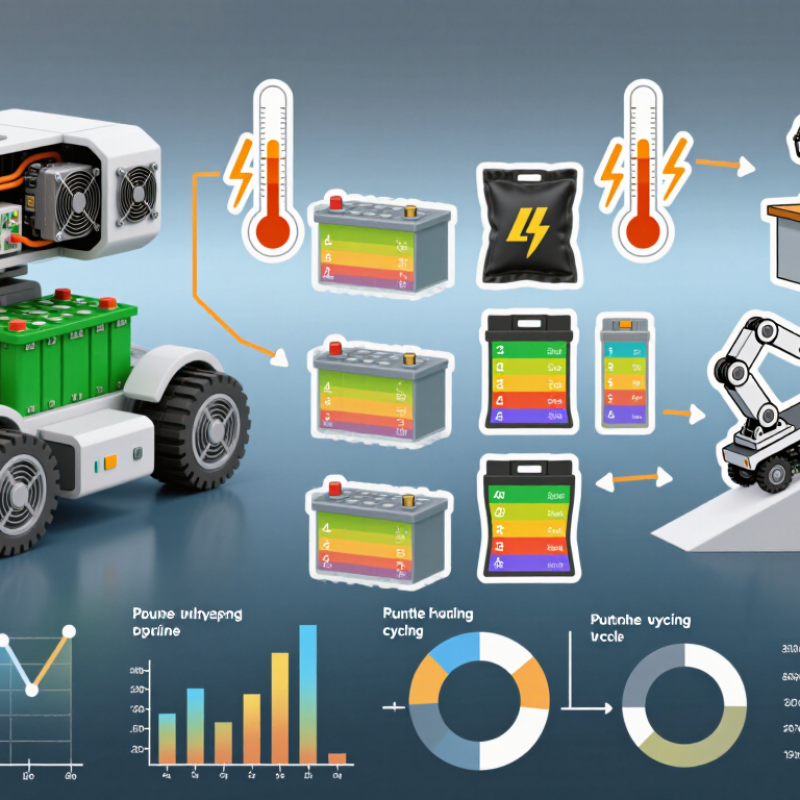
How to Choose Robotics Battery Systems?

Define the Robot’s Power and Operating Requirements

A robot’s battery should be sized around its real work, not its advertised runtime. Start by listing each load: drive motors, controllers, sensors, grippers, and onboard computers. Record their voltage and typical current, then check brief peaks during acceleration or lifting. Peak demand matters. A battery that handles average current may still trigger voltage drops when a motor starts. Measure current during a representative task if possible; estimates from component labels can miss startup surges.

Next, define the operating pattern. Note active hours per shift, pauses, travel distance, payload, and how often the robot climbs ramps or turns in place. A warehouse robot moving on smooth floors needs a different energy margin from a machine lifting repeatedly. Decide how much runtime reserve is practical, and include energy used by lights, radios, and cooling. Ambient temperature and enclosure space also matter: cold conditions can reduce usable capacity, while a tight compartment limits heat dissipation. Check charger access and acceptable recharge time before choosing capacity. Keep battery mass in the calculation; extra capacity can change handling and motor demand. Early figures will be imperfect. Revisit them after logging a full work cycle, especially if the robot spends more time waiting or carrying loads than expected.

Compare Battery Chemistries and System Configurations

When choosing a robotics battery system, compare chemistry and pack layout against the robot’s real duty cycle. An arm that accelerates often needs strong peak-current delivery; a mobile platform may prioritize runtime and low mass. Lithium-ion cells offer high energy per kilogram, while lithium iron phosphate typically favors thermal stability and long cycle life. Nickel-metal hydride can tolerate rough handling, but its lower energy density may add weight. Trade-offs matter.

Do not compare chemistry by capacity alone. Check the cell voltage range, continuous and peak current, operating temperature, charge time, and expected cycle count. Then consider configuration: series-connected cells raise pack voltage, while parallel strings increase available capacity and current. More cells also mean more connections, protection needs, and possible failure points. Fit, mass, and service access count.

A single compact pack may simplify wiring, while a modular arrangement can make replacement easier but add connection points. Either design needs a battery management system matched to the chemistry, with protection against overcurrent, undervoltage, and excess temperature. Test under actual loads: repeated starts, braking, payload changes, and cold-room operation can expose voltage sag or hot connectors. Bench tests can mislead. Leave margin for aging, but avoid an oversized pack that wastes payload capacity.

Calculate Capacity, Voltage, and Runtime Needs

How to Choose Robotics Battery Systems?

Estimate runtime from the robot’s actual work cycle, not its idle current. Record current while motors accelerate, carry a load, turn, and pause. Average those readings across a representative mission. Runtime in hours is approximately usable capacity in amp-hours divided by average current. For example, a 20 Ah battery delivering 8 A for most of a shift offers about 2.5 hours before allowances. Peak current matters too: a battery may have enough capacity but still sag during a hard start.

Match battery voltage to the controller and motors across the battery’s full operating range. Estimate energy as nominal voltage multiplied by amp-hours, then allow for discharge limits, temperature, aging, and conversion losses. NREL’s 2024 Annual Technology Baseline uses about 85% round-trip efficiency for utility-scale lithium-ion storage. That is not a robotics battery specification, but it shows why nominal energy should not be treated as fully usable. Measure your own system. Real duty cycles can be surprisingly uneven.

Tips: Add roughly 20% runtime margin for changing loads and battery aging, then validate it with a timed floor test. Check connector and fuse ratings against measured peak current. Keep a log of voltage under load; it may reveal a weak pack before runtime drops sharply. A little inconvenient, but worth it.

Assess Charging, Safety, and Mechanical Integration

A battery choice should start with the robot’s duty cycle, not its catalogue capacity. The International Federation of Robotics reported 4.28 million industrial robots operating worldwide in 2023 (World Robotics 2024). For mobile machines, frequent charging can shape uptime as much as runtime. Check the charger’s voltage and current against the battery maker’s limits, then confirm that charging fits the actual shift pattern. A short charging window may demand more current, which can increase heat. Small details matter.

Safety needs practical checks, not just a specification sheet. Confirm that the battery management system monitors cell voltage and temperature, and that protective cutoffs suit the robot’s load and charger. The International Energy Agency estimated electric-car battery demand at about 750 GWh in 2023, up roughly 40% from 2022 (Global EV Outlook 2024). That growth reflects a rapidly scaling battery industry, but it does not prove a particular pack is suitable for robotics. Review test evidence, including relevant industrial battery safety standards such as IEC 62619, and assess charging in the robot’s real enclosure. A bench test alone can miss trapped heat.

Mechanical integration is easy to underestimate. Check mounting points, cable bend radius, connector access, vibration exposure, and the pack’s effect on the robot’s center of gravity. Leave room for inspection and replacement; a battery that fits only after forcing a cable is not a good fit. CAD models can look convincing, yet omit service access or a sharp edge near wiring. That deserves another review.

Test Battery Performance Under Real Operating Conditions

A battery’s advertised capacity tells only part of the story. Test it on the robot, carrying a realistic payload and running the actual movement pattern. A warehouse unit that pauses often may draw little power at rest, then demand a sharp burst when lifting or accelerating. Record current, voltage, and temperature during both phases. Small details matter.

Repeat the test on the real floor, not only on a clean bench. Ramps, rough joints, tight turns, and frequent stops can change energy use considerably. Run the system through a full shift, including its normal idle periods. Note when voltage dips, motors slow, or the battery enclosure warms. Leave sensors and control electronics active; they still consume power. Test it again.

Compare results across several runs, with the same load and starting charge. A single trial can be misleading, especially if the battery is warm or recently charged. Measure usable runtime, recharge time, and how much capacity remains after the robot reports low charge. Check that the battery-management system handles brief current peaks without shutting down. Some test conditions are hard to reproduce exactly, so document the floor, payload, ambient temperature, and software settings. Imperfect records are still better than relying on memory.

FAQS

How should I choose a battery chemistry for a robot?

Match chemistry to the robot’s duty cycle. Lithium-ion is light for its energy, while lithium iron phosphate favors thermal stability and long cycle life. Nickel-metal hydride can handle rough treatment but may add weight. Trade-offs remain.

Why shouldn’t I compare batteries by capacity alone?

Check voltage range, continuous and peak current, operating temperature, charging time, and expected cycle count. A pack with a large capacity may still struggle during a fast lift.

What do series and parallel cell layouts change?

Series connections raise pack voltage. Parallel strings increase available capacity and current. More cells also add connections and possible failure points. Fit matters too.

Is a single pack better than a modular battery arrangement?

A compact pack can simplify wiring. Modular packs may be easier to replace, but they add connection points. Service access deserves attention.

What should a battery management system protect against?

It should match the battery chemistry and protect against overcurrent, undervoltage, and excess temperature. Check whether it handles brief current peaks without shutting down.

How can I test a battery under realistic conditions?

Run the robot with a representative payload and its normal movement pattern. Record current, voltage, and temperature during idle periods and demanding bursts. Small details matter.

Which operating conditions can change battery performance?

Ramps, rough floor joints, tight turns, frequent stops, and cold rooms can affect energy use. Test on the actual floor, not only on a clean bench. Bench results can mislead.

What should I record during a full-shift test?

Note usable runtime, recharge time, voltage dips, motor slowdowns, enclosure warmth, and remaining capacity at low charge. Include floor, payload, ambient temperature, and software settings. Records may be imperfect, but memory is worse.

Conclusion

Choosing Robotics Battery Systems begins with a clear understanding of the robot’s power demands, duty cycle, operating environment, and required runtime. These requirements help narrow the choice of battery chemistry and system configuration. Next, estimate the necessary capacity and voltage based on the robot’s expected load and energy use, allowing for practical operating margins rather than relying on ideal conditions.

A suitable system should also fit the robot’s available space and weight limits, support an appropriate charging approach, and include measures for safe operation and monitoring. Before finalizing a design, test the battery under realistic workloads and environmental conditions. Checking runtime, temperature, voltage stability, and charging behavior can reveal whether the system meets operational needs and help guide adjustments for dependable performance.


Julian Mercer

Julian Mercer

Julian Mercer is a seasoned marketing professional and a trusted voice behind the company’s expert blog. With a strong understanding of market strategy, customer behavior, and product development, Julian transforms complex ideas into clear, practical insights that help businesses make confident......